

16 Feb 2026
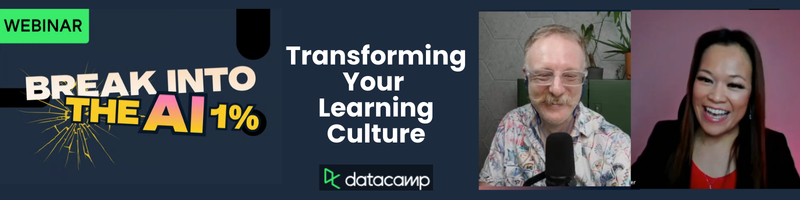
Rosanne Werner featured on DataCamp's "Break into the AI 1%" Webinar for a candid conversation about why so many AI programmes stall - and what it takes to get people genuinely using AI, not just paying for it.
The episode cuts straight to the heart of the adoption challenge. Technology readiness is rarely the bottleneck. The real barrier is human: uncertainty, habit, fatigue, and the quiet fear of getting it wrong. Rosanne explains how this "human firewall" shows up across organisations and why traditional AI literacy programmes - long e-learning modules and slide-heavy workshops - often produce certificates but not sustainable behaviour change.
Key topics covered
💡 Why AI readiness is a people challenge, not a technology problem
💡 Human biology and the science behind how the brain reacts to change
💡 How microlearning, repetition, and small reward loops build lasting capability where most AI literacy courses fall short
💡 The role of social learning in making experimentation feel safer, memorable and more visible
💡 A practical habit framework: define a craving, create a cue, lower friction, and make the reward feel immediate
Whether you’re leading an AI initiative, managing a team, or looking to embed AI into your daily work, this webinar offers practical insights and actionable frameworks to turn curiosity into real adoption.
Watch the Full Episode HERE
to see how to break through the human firewall and make AI usage routine, effective, and impactful.
Ready to empower your people on the Data and AI Journey?

Summary:
Overcoming the “Human Firewall” in AI Adoption
Investing in AI is one thing. Getting your teams to actually use it is another.
In the recent webinar with DataCamp, Rosanne Werner highlighted why most AI initiatives stall: it’s rarely about technology. The real barrier is human.
Uncertainty, habits, fatigue, and fear of failure form a “human firewall”, blocking adoption in predictable ways. Some employees wait for proof, others consume content without acting, while efficiency-driven staff chase shortcuts. Add low engagement and high burnout, and even the best AI roadmap can fail to take hold.
Making AI Stick
Rosanne emphasised training that works with the brain, not against it:
Microlearning: short, repeated sessions that reinforce memory.
Real use cases: AI applied to everyday tasks.
Small rewards: gamified feedback and recognition to sustain effort.
Learning Together
Social learning - peer groups, forums, and team challenges - reduces fear, normalises experimentation, and spreads practical skills. Seeing others try and succeed makes AI adoption feel safer and achievable.
Habit-Driven AI Adoption
The session introduced a simple framework for making AI usage routine:
Craving: connect AI to what employees care about—time saved, confidence, reduced stress, recognition.
Cue: attach the behaviour to a clear trigger—a time, place, or event.
Reward: make the payoff immediate and visible.
Lower friction: remove barriers so adoption becomes effortless.
Small, repeated behaviours compound into lasting change, transforming AI from a tool people ignore into a habit they rely on.
Bottom line:
AI success isn’t about platforms, models, or pipelines—it’s about people. Build the right habits, create safe spaces for learning, and adoption follows.